
CRM in healthcare helps hospitals build lasting relationships with patients through data and care processes throughout the examination and treatment journey.
A medical visit may end when the patient leaves the hospital, but the healthcare journey does not stop there. Patients still need reminders for follow-up appointments, treatment monitoring, necessary guidance, and ongoing communication with the healthcare facility when needed. If these activities are carried out separately, the patient experience will lack continuity, and the hospital will also find it difficult to build long-term relationships.
That is why many healthcare facilities are beginning to pay attention to CRM in healthcare as a platform that supports information management, personalizes the care process, and improves service quality. Not only does CRM support customer care activities, but it also helps hospitals leverage data more effectively to build a consistent and sustainable patient care journey.
Patient care needs to be maintained throughout the entire journey
The patient experience is determined not only by the quality of medical examination and treatment but also by how the hospital accompanies patients before, during, and after each visit. When all information is stored completely and care activities are carried out at the right time, patients will feel cared for throughout the journey rather than through isolated interactions.
CRM helps hospitals organize this journey systematically. Patient information is managed centrally, making it easier for medical teams and customer care departments to track interaction history and proactively implement appropriate care activities.
CRM helps personalize the healthcare experience
Every patient has different needs, health conditions, and treatment histories. Therefore, applying the same care process to all patients will make it difficult to deliver an optimal experience.
CRM systems help hospitals store and leverage individual patient information to develop more appropriate care programs. From follow-up appointment reminders and post-treatment guidance to periodic care, all activities can be carried out based on centrally managed data.
When the experience is personalized, patients feel more cared for, while hospitals can also improve service quality without significantly increasing the workload of their staff.
Centralized data improves coordination efficiency
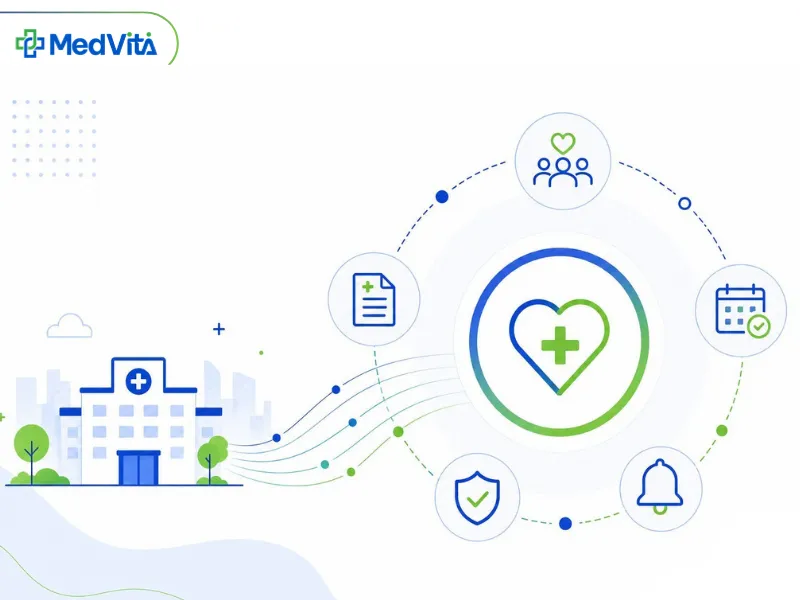
One of the important values of CRM in healthcare is its ability to connect data on a single platform. When information is fully updated, relevant departments can access the same data source without having to search for or re-enter information multiple times.
Centralized management helps reduce the time spent processing information, minimize errors during the care process, and enable departments to coordinate more effectively. Patients also do not have to provide the same information repeatedly when interacting with different departments within the hospital.
This is an important factor in improving consistency throughout the entire care journey.
CRM supports maintaining patient connections
Maintaining communication with patients after the examination and treatment process ends brings many benefits to both sides. Patients gain an additional channel for receiving necessary information, while hospitals have better conditions to monitor and accompany them over the long term.
CRM systems can support the management of follow-up appointments, sending notifications and reminders, or implementing care programs for different patient groups. These activities are carried out based on data rather than manual operations, helping customer care teams work more efficiently.
The relationship between the hospital and the patient therefore does not end with a single visit but is maintained throughout the healthcare journey.
CRM contributes to optimizing operational efficiency
In addition to improving the patient experience, CRM also helps hospitals organize care activities more systematically. When data is centralized and processes are standardized, many administrative tasks can be shortened or automated.
As a result, staff spend less time on repetitive tasks and have more opportunities to focus on activities that directly benefit patients. At the same time, management gains more data to evaluate the effectiveness of care programs and make adjustments when necessary.
CRM is therefore not only a customer management tool but also contributes to improving hospital operational efficiency.
CRM is part of the smart hospital ecosystem
In a smart hospital model, data does not exist in isolation but needs to be connected across multiple systems. CRM serves as a bridge between medical examination and treatment activities and patient care activities, helping information flow throughout the entire journey.
When CRM is connected to other management platforms, hospitals can build a unified data ecosystem. This provides a foundation for AI technologies, data analytics tools, and automation solutions to deliver greater value during operations.
As a result, hospitals can not only improve the quality of care but also gradually complete a modern management model centered on patients.
MedVita supports the development of CRM systems in healthcare
MedVita is developed with the goal of supporting healthcare facilities in building an ecosystem for patient management and care on a unified data platform. CRM is an important component that connects information, standardizes care processes, and enhances interaction between hospitals and patients.
In addition to centralized data management capabilities, MedVita also integrates AI technologies to support data analysis, automate certain care activities, and provide information for management and operations. These AI technologies are designed to work alongside healthcare teams, helping reduce repetitive tasks and improve management efficiency while keeping people at the center.
Combining CRM with other management platforms within MedVita enables hospitals to build a seamless care process while creating a foundation for development toward the smart hospital model.
CRM provides the foundation for a comprehensive patient care journey
CRM in healthcare not only helps hospitals manage patient information but also contributes to building long-term relationships based on data and continuous connectivity. When deployed on a platform capable of integrating data and suitable AI technologies, CRM becomes a tool that supports improved patient experience, optimized operational efficiency, and sustainable service quality. With a people-centered approach, MedVita MedVita supports healthcare facilities in building modern CRM systems, contributing to the development of the smart hospital model of the future.