

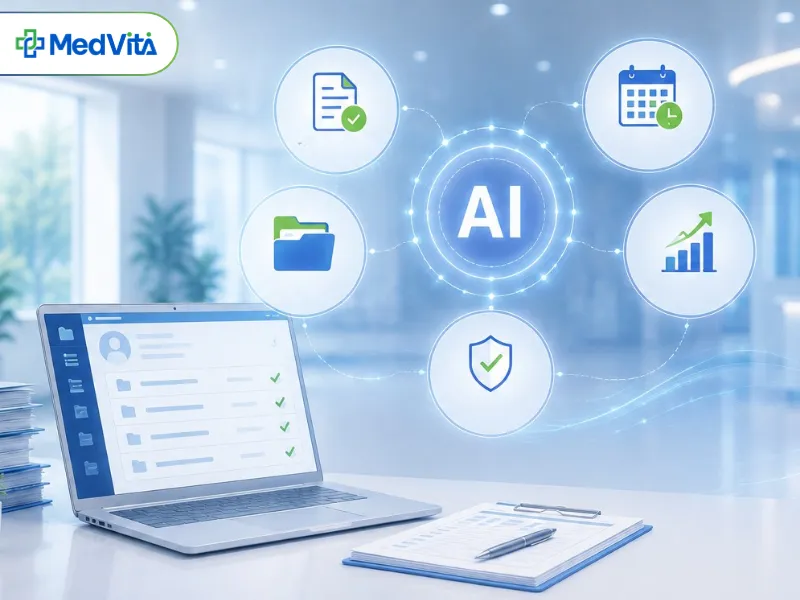
AI medical administrative assistant systems are supporting hospitals with medical record documentation, form creation, data standardization, and administrative tasks.
For many years, hospitals have continuously invested in technology to improve the quality of medical care and optimize operational activities. However, a common reality is that healthcare professionals still have to spend a large amount of time on administrative tasks such as documenting medical records, completing paperwork, creating forms, and processing data.
This is also why an increasing number of healthcare facilities are interested in AI medical administrative assistants. Instead of participating in specialized treatment activities, AI focuses on supporting repetitive administrative tasks, helping reduce the workload for doctors and healthcare professionals.
What tasks are AI medical administrative assistants supporting?
Supporting electronic medical record documentation and completion
One of the most common applications of AI in hospitals is supporting electronic medical record documentation.
The system can record the content of medical consultations, convert speech to text, and automatically fill in the appropriate information fields in medical records. Instead of spending many minutes after each consultation completing records, doctors can receive a summarized and pre-organized record.
This significantly reduces manual data entry time while also limiting the risk of missing important information during documentation.
Supporting the creation of treatment forms and medical forms
Hospitals operate using many different types of forms, such as order forms, treatment forms, administrative records, and documents related to the medical examination and treatment process.
AI can support the creation of forms based on standard structures using data that has already been recorded. Information is automatically entered into the appropriate fields, helping reduce the workload for healthcare professionals.
Standardizing forms also helps reduce errors during the recording and storage of information.
Supporting the aggregation and retrieval of patient information
In healthcare environments, finding patient information can often take a significant amount of time when data is stored across multiple systems.
AI can support the retrieval of medical history, aggregation of test results, diagnoses, and related information within a short period of time. Instead of manually searching through multiple screens or records, healthcare professionals can access the necessary information more quickly.
This is particularly useful for hospitals with large numbers of medical records and frequent information retrieval needs.
Supporting healthcare data standardization
Healthcare data is highly valuable but often exists in many different formats.
AI can support the standardization of medical terminology, the harmonization of data structures, and the detection of missing or inconsistent information fields. When data is standardized, storing, retrieving, and utilizing information becomes more efficient.
This is also an important foundation for hospitals to improve data governance quality over the long term.
Supporting repetitive administrative tasks
Many administrative tasks in hospitals are performed according to fixed processes and repeated every day.
AI can support the completion of records, report aggregation, form management, and the processing of clearly structured workflows. These tasks often do not require medical expertise but consume a significant amount of healthcare professionals' time.
Automating repetitive tasks allows healthcare teams to focus more on activities that provide direct value to patients.
What value do AI medical administrative assistants bring to hospitals?
Reducing the administrative burden on healthcare professionals
The increasing volume of paperwork and records is creating significant pressure on hospitals.
When AI takes on part of the data entry and record processing workload, healthcare professionals can significantly reduce the time spent on administrative tasks. This not only helps reduce workload pressure but also limits overload in healthcare environments.
Giving doctors more time for patients
The greatest value of AI in healthcare administration is not the speed of data processing but the time it frees up for doctors.
When the time required to complete records is shortened, doctors have more opportunity to spend time examining, communicating with, and monitoring patients. This is an important factor in improving the quality of healthcare and the treatment experience.
Improving hospital operational efficiency
Administrative processes are carried out more quickly and consistently with the support of AI.
Records are processed promptly, administrative errors are minimized, and the productivity of healthcare teams is improved. This helps hospitals operate more efficiently even as the number of patients continues to increase.
Improving healthcare data quality
Complete and consistent data is the foundation of all hospital management activities.
AI helps limit missing data, duplicate data, and errors that arise during data entry. When data quality improves, hospitals can make more effective use of information for medical care, management, and research.
Creating a foundation for management and healthcare activities
When data is better organized, hospitals can more easily track patient records, perform statistical analysis, and create reports for management.
This data also supports evidence-based decision-making, helping healthcare facilities improve operational quality and healthcare services.

Why are AI medical administrative assistants becoming an important tool in hospitals?
AI medical administrative assistants is directly supporting many administrative tasks that traditionally consume significant amounts of doctors' and healthcare professionals' time.
From documenting medical records and creating forms to aggregating and standardizing data, AI significantly reduces repetitive tasks in hospitals. As a result, healthcare teams can focus more on their professional expertise and patient care activities.
As workloads continue to increase and staffing pressures remain a major challenge for the healthcare industry, AI is gradually becoming an important support tool that helps hospitals operate more efficiently and make better use of healthcare data.