

AI patient intake support is used to collect information, triage, standardize data and support the pre-examination intake process at hospitals.
The patient intake process is the first step in the healthcare journey at hospitals and clinics. This is also the stage where waiting, overload and errors can easily occur if the process is handled entirely manually.
The development of artificial intelligence is opening a new approach to patient intake activities. Instead of only supporting data storage like traditional software, AI can participate in many stages before patients meet doctors, from collecting information to supporting triage and preparing medical records.
What is AI patient intake support?
The role of AI in the pre-examination stage
AI patient intake support is an artificial intelligence application system designed to support activities that take place before patients enter the examination process.
During this stage, AI can help collect initial information, record symptoms, receive healthcare needs and guide patients through necessary steps before meeting a doctor.
Instead of requiring healthcare staff to handle the entire intake process manually, AI automates many repetitive tasks, thereby reducing pressure on intake areas and improving operational efficiency.
How is AI patient intake support different from regular medical appointment registration software?
Most traditional medical appointment registration systems are designed to store and manage data. Patients enter information, the system records it and transfers data to related departments.
Meanwhile, AI can interact and process information at a higher level. The system can ask additional questions to clarify symptoms, analyze collected data and provide suitable suggestions based on the specific context of each patient.
This helps make the intake process more proactive rather than simply recording data.
AI supports rather than replaces healthcare staff
A common belief is that AI will replace healthcare staff in the intake process. In reality, AI's role is to support rather than replace.
AI does not make treatment decisions, does not replace doctors or nurses and does not take professional responsibility for patients.
Instead, the system handles repetitive tasks such as collecting information, standardizing data and supporting coordination. As a result, healthcare teams can focus more on tasks requiring expertise and direct interaction with patients.
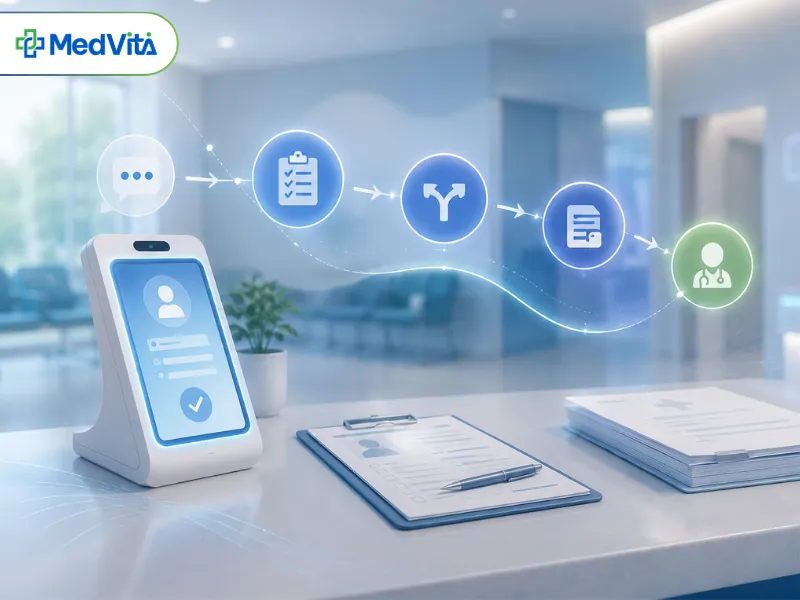
How does AI patient intake support work?
Automatic patient information collection
One of AI's first tasks is collecting data related to patients. The system can record basic information such as full name, age, health insurance information, medical history and current symptoms. This process can be performed through chatbots, mobile applications, websites or self-service devices at hospitals.
Automating information collection helps reduce declaration time at counters and limits missing data.
Analysis and standardization of intake data
After receiving information, AI continues to process and standardize the input data. Information is arranged according to a unified structure, duplicate data is removed and missing fields are clarified. As a result, intake records become more complete and consistent.
Data standardization helps significantly reduce errors caused by manual entry and creates a foundation for the next steps in the healthcare process.
Support for patient triage
Triage is one of the most important tasks in patient intake. Based on recorded symptoms, AI can support recommendations for suitable specialties or guide the corresponding intake process. This helps limit cases where patients register for the wrong specialty or have to move multiple times between areas in the hospital.
When triage is performed more effectively, pressure in the intake area is also significantly reduced.
Summarizing information for doctors before examination
Before patients meet doctors, AI can compile all collected information into a concise summary.
The system highlights key symptoms, medical history and important information so doctors can quickly understand the patient's condition.
As a result, doctors can better prepare for examinations and reduce the time spent reviewing initial records.
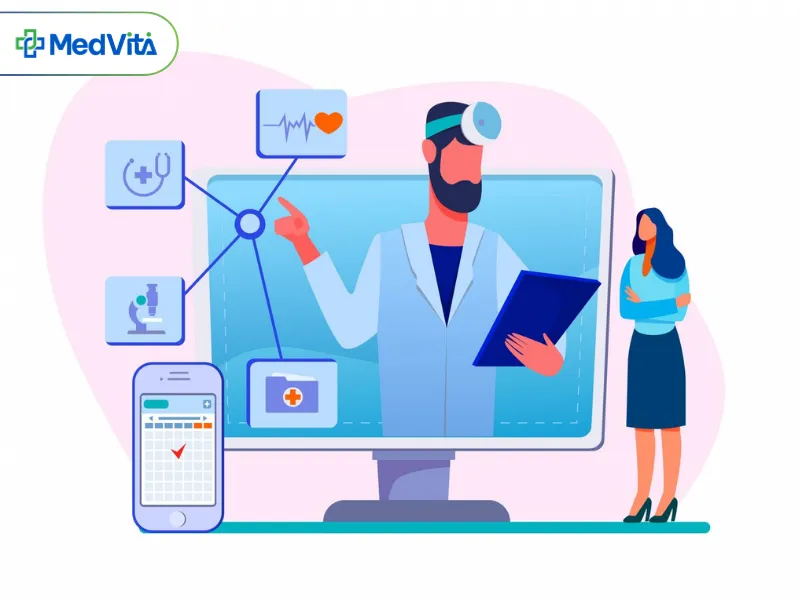
What tasks is AI supporting in the patient intake process?
Support for medical appointment registration
AI can participate in the entire online medical appointment registration process. Patients can provide personal information, choose examination times and receive appointment confirmations without performing many manual steps or waiting at intake counters. This helps reduce pressure on intake staff during peak hours.
Support for initial symptom collection
Through structured conversations, AI can record reasons for medical visits and symptoms that patients are experiencing.
The system asks appropriate questions to collect additional necessary information, thereby forming an initial record for the intake process.
Early symptom collection provides hospitals with more data to coordinate patients more effectively.
Support for patient coordination
After obtaining sufficient information, AI can help guide patients to the correct process or suitable specialty.
Good coordination helps reduce overcrowding in one intake area while limiting cases requiring department transfers or repeated registrations.
This is an important factor in improving patient experience from the very first steps.
Support for preparing medical examination records
AI can also support the creation of initial intake records and synchronize data with hospital management systems.
When patients meet doctors, necessary information is already prepared, helping the examination process proceed more smoothly and efficiently.
This is especially useful for hospitals with large patient volumes and many records to process each day.
AI patient intake support helps optimize healthcare operations
AI patient intake support is a system that automates and optimizes activities taking place before patients meet doctors.
This technology can support information collection, data standardization, patient triage and medical record preparation more quickly and consistently.
Instead of replacing the healthcare team, AI acts as an assistant during the intake stage, helping reduce operational pressure and enabling healthcare staff to focus more on patient care activities.