

Smart reception supports medical history collection, patient routing, and information summaries before examination, helping hospitals optimize reception processes.
Before meeting doctors, patients usually go through many steps from registration and information provision to waiting for guidance to the right examination area. These are not merely initial procedures but also a stage that creates important data for the entire care process. If information is collected and processed effectively from the beginning, both patients and medical teams can save time in later steps.
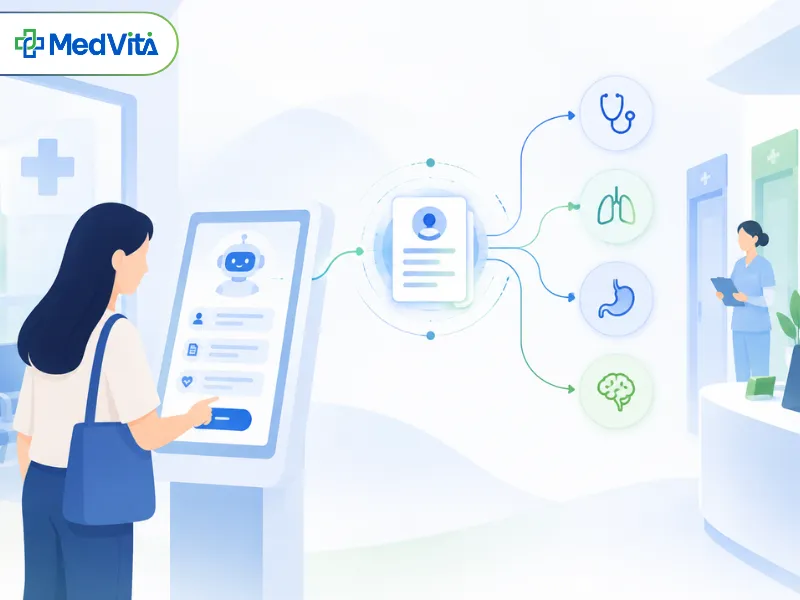
Smart Reception by MedVita focuses on optimizing this starting point. Through the MedVita application, AI supports medical questioning and medical history collection at home or in hospitals, then analyzes initial information to assist routing and suggest suitable specialties. Medical history is also summarized into a structured report sent to doctors, making pre-examination information intake more seamless.
Reception is not only a procedure before examination
Reception is often the first point where patients interact with hospital operations. However, its value is not only in confirming administrative information. This stage is also when hospitals can begin collecting data related to symptoms, medical history, medications, and other necessary information before patients meet doctors.
If most information is only collected after patients enter examination rooms, doctors must spend part of the consultation asking questions and compiling medical history. Meanwhile, patients also need to provide relevant data before discussing specialized issues. Preparing information early can help organize this process better.
MedVita Smart Reception therefore moves data collection forward in the patient journey. Instead of waiting until entering the examination room, patients can use the MedVita app to provide information at home or in hospitals. Prepared data creates a foundation for smoother routing and examination steps.

AI system supports medical history preparation before meeting doctors
One of the main functions of Smart Reception is AI medical questioning and medical history collection. The AI tool conducts question-and-answer processes to record symptoms, medical history, current medications, and related information. Instead of starting the entire information collection process at the examination room, part of the data can be prepared beforehand.
After collection, information is summarized into a structured medical history report. This report is sent to doctors to support their access to patient information. Doctors therefore have prepared information before conducting examinations and professional assessments.
The value of AI here lies in supporting data collection and organization rather than replacing doctors' questioning or assessment. Doctors remain responsible for verifying information, communicating directly with patients, and making professional decisions. Technology helps prepare data so doctor-patient interaction time can be used more effectively.
Early routing helps the patient journey run more smoothly
After receiving initial information, MedVita's AI system can analyze data to support routing and suggest suitable specialties. This step connects patient-provided data with the pre-examination navigation process. Instead of only storing information, data begins to support patient flow organization.
Reduce waiting time and optimize patient flow
When information is prepared in advance and patients receive routing support from the reception stage, hospitals have better conditions to organize smoother examination journeys. According to MedVita's product direction, Smart Reception aims to reduce waiting time and optimize patient flow. These two benefits are directly connected because a clear reception process helps patients reach the appropriate step earlier.
Optimizing patient flow also has significance for hospital operations. When the beginning of the journey is well organized, following departments can receive patients with prepared information. Reception becomes part of a continuous operating process rather than a separate administrative step.
Shorten examination time and increase time for specialized care
Part of consultation time is often used for doctors to collect and summarize initial information. When medical history is collected beforehand and presented in a structured summary, doctors can access this information before or during examination. MedVita aims for this function to contribute to shorten examination time and increase specialized care time.
This does not mean the system replaces doctors verifying medical history with patients. AI supports preparation and information arrangement, while doctors still evaluate data based on expertise and actual conditions. Time savings come from reducing tasks that can be prepared beforehand so people can focus more on specialized work.
Smart Reception creates value for both patients and medical teams
For patients, a convenient reception process can improve experience even before entering the examination room. Providing information at home or in hospitals makes preparation more proactive, while routing support helps organize the following journey clearly. Patients are not only received but also placed into a continuous information flow from the first point.
For doctors, the value lies in having collected and summarized medical history information in advance. Instead of starting with completely unorganized data, doctors have a summary for reference and further verification during examination. Technology becomes a support tool for doctor-patient interaction rather than replacing it.
From an operational perspective, Smart Reception connects activities that may otherwise be separate, including medical history collection, routing, specialty suggestions, and information transfer to doctors. When these steps are part of one workflow, hospitals gain a foundation to reduce waiting time and manage patient flow more effectively.
MedVita applies AI technology where it best supports people
Smart Reception is part of MedVita's direction toward becoming an AI platform supporting smart hospital operations. Instead of adding AI only to automate more tasks, the solution focuses on areas where technology can help people process information effectively. From medical history collection to routing and data summarization, each function connects to a specific step in the pre-examination journey.
This approach also clarifies the role between AI systems and medical teams. AI can ask questions, collect, analyze, and organize information to support workflows, but doctors remain responsible for receiving data and performing professional assessments. Technology is positioned as a companion that reduces tasks that systems can support.
When the reception point connects with activities afterward, the value is not only a faster single step. Hospitals can move toward a care journey where data is prepared early, information is transferred smoothly, and medical teams have more time for activities requiring direct human involvement.
An effective examination journey can begin with reception
Smart Reception of MedVita aims to change how information is prepared before patients meet doctors through AI systems supporting medical questioning, history collection, routing, specialty suggestions, and structured summaries. When these first steps are connected in one process, hospitals have better conditions to reduce waiting time, shorten examinations, optimize patient flow, and spend more time on specialized care. This is also a way to MedVita bring AI technology back to its proper role of supporting people so healthcare becomes more convenient for patients and more effective for medical teams.