
The smart hospital model is changing the way healthcare facilities operate, connect data, and improve the quality of patient care. What creates this model?
Every day, a hospital must process thousands of medical visits, tens of thousands of healthcare data records, and coordination among various departments. As operational scale continues to grow, managing through fragmented processes gradually reveals many limitations. This is also why the smart hospital model has become a direction chosen by many healthcare facilities to improve management efficiency and patient care quality.
The number of patients is increasing, operational processes are becoming more complex, while requirements for service speed and quality are also higher. This makes hospitals need solutions capable of connecting data, reducing manual work, and supporting healthcare teams in making more effective decisions.
So what is the smart hospital model, what characteristics does it have, and what solutions are suitable for gradual implementation? The article below will help you better understand the model
What is the smart hospital model?
Smart hospital model, or Smart Hospital, is a model that applies digital technology to connect people, processes, and data throughout all hospital operations.
The goal of this model is to improve management efficiency, support professional activities, and enhance patient experience. Technology does not operate separately but is integrated into each specific process, from appointment registration, record storage, and test orders to operational management.
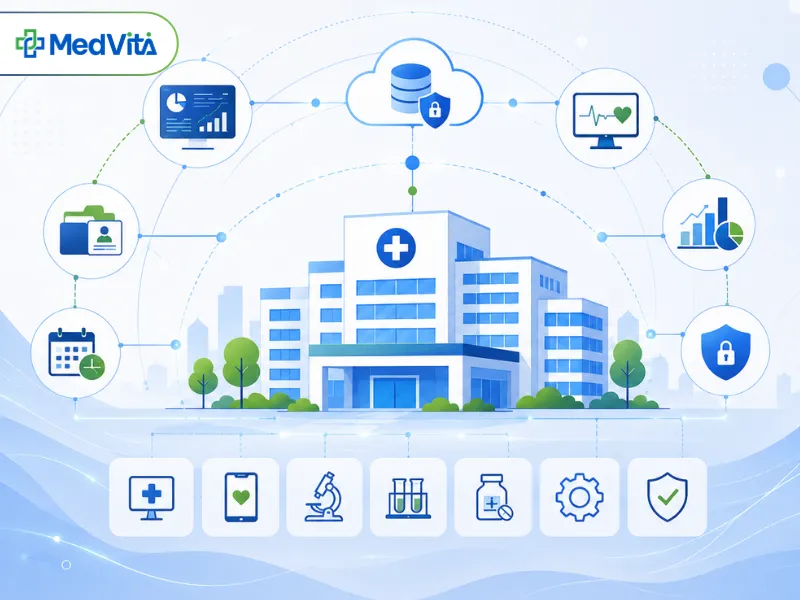
Unlike simply deploying a few separate software solutions, smart hospitals aim to build a unified ecosystem. In this ecosystem, data between departments can be shared, updated, and utilized in real time.
A smart hospital can apply electronic medical records, artificial intelligence, Internet of Things, big data, cloud computing, and operational dashboard systems. However, technology is only a tool. The most important factor remains the ability to help doctors, nurses, and managers work better.
AI in smart hospitals is not intended to replace people. The role of AI is to process data, provide additional reference information, and support healthcare teams in making decisions faster and more accurately.
7 characteristics of the smart hospital model
1. Centrally connected data
One of the most important characteristics of the smart hospital model is the ability to connect data between systems.
Administrative information, medical history, test results, diagnostic images, and treatment processes are stored systematically. When needed, authorized users can quickly access information without searching through multiple different sources.
Data connectivity helps reduce repeated data entry. At the same time, it supports reducing errors and improving coordination between departments.
2. Automated processes
In traditional hospitals, many tasks are still performed manually. This can cause delays, create pressure on staff, and make patients wait longer.
In the smart hospital model, some processes can be automated, such as appointment registration, schedule management, queue number taking, patient calling, or payment.
Automation does not mean eliminating the role of people. The goal is to reduce repetitive tasks so healthcare staff have more time to focus on professional work and patient care.
3. AI supports decision-making
AI is one of the important technologies in the process of building smart hospitals.
Through its ability to process large amounts of data, AI can support anomaly detection, information summarization, and alerts. In some cases, the system can also provide reference data to support diagnosis or treatment.
However, AI does not replace doctors' professional assessments. Final decisions still need to be based on the experience, knowledge, and responsibility of healthcare teams.
This approach helps technology become a partner rather than a factor that reduces the role of people in healthcare.
4. Data-driven management
In traditional models, leaders often have to wait for reports compiled daily, weekly, or monthly. This can make responses to operational issues not fast enough.
With smart hospitals, data can be continuously updated on management systems. Managers can monitor bed capacity, patient flow, waiting times, or performance of each area.
Data-driven management helps hospitals identify issues earlier. From there, decisions on staff coordination, resource allocation, or process improvement can be made promptly.
5. Improved patient experience
Smart hospitals do not only focus on internal technology. Another important goal is to create a more convenient healthcare journey for patients.
Patients can schedule appointments in advance, receive appointment notifications, look up results, and track some information related to the treatment process. Tasks that previously required direct interaction can be supported through digital platforms.
This helps reduce administrative procedures and limit waiting time. More importantly, patients can access clearer information at each stage of their healthcare journey.
6. Increased coordination between departments
In a hospital, examination and treatment processes often involve multiple departments. If information is not shared promptly, coordination can be interrupted.
The smart hospital model enables data to be updated and exchanged between departments. Doctors can access test results, diagnostic images, or treatment history on the same system.
As a result, related departments can coordinate faster. Patients also do not have to provide the same information multiple times in different areas.
7. Real-time data updates
The ability to update data in real time helps hospitals respond faster to changes in operational activities.
Management teams can detect overload in an area, monitor fluctuations in patient volume, or identify issues arising in processes.
Real-time data not only supports operations. It is also the foundation for hospitals to build analytical and forecasting models for long-term development plans.
Benefits of the smart hospital model
Smart hospital model bring value to patients, healthcare teams, and managers.
For patients, this model makes the healthcare journey more convenient and transparent. Waiting time can be reduced, procedures simplified, and information accessed more easily.
For doctors and nurses, well-organized data helps make searching faster. Healthcare staff can also reduce administrative tasks to focus more on professional expertise.
For leaders, data becomes the foundation for monitoring operations and making decisions. Issues related to overload, performance, or resource allocation can be identified more clearly.
In the long term, smart hospitals also help build a flexible operating foundation. When needs change, hospitals can expand or adjust the system without having to redeploy everything from the beginning.
Challenges when implementing the smart hospital model
Despite providing many benefits, building a smart hospital is not a process that can be completed in a short time.
One common challenge is that data is scattered across multiple systems. Software deployed at different times may not be designed to connect with each other.
In addition, the transformation process also involves changes in workflows. Staff need guidance to understand how to operate new systems and use technology effectively.
Information security is also an important factor. Medical data is highly sensitive, so hospitals need appropriate authorization, security, and access control mechanisms.
Initial investment costs can also become a barrier. Therefore, many hospitals choose phased implementation, starting with the most urgent issues before expanding to other areas.
To reduce risks, hospitals should avoid implementing separate software solutions without an overall architecture. A suitable solution needs the ability to integrate, expand, and provide long-term support.
MedVita – A partner solution for building smart hospitals
Building smart hospital model is not simply about investing in more technology. It is a comprehensive process of changing how hospitals manage data, organize processes, and support people in their work.
MedVita is developed with the vision of becoming a partner solution for healthcare facilities during digital transformation. The platform aims to connect data, optimize processes, and apply AI in a human-centered way.
Instead of replacing doctors or nurses, MedVita focuses on providing support tools. Technology helps healthcare teams access information faster, reduce repetitive tasks, and have more data for professional decisions.
For managers, MedVita aims to support data monitoring and improve operational efficiency. When information is connected, hospitals can identify issues more clearly and develop appropriate improvement plans.
For patients, optimizing processes and connecting data can contribute to a more convenient experience. Patients are served through a consistent, transparent journey with fewer unnecessary procedures.
With the philosophy AI accompanies, does not replace people, MedVita aims for a responsible technology application model. In which AI supports people in making better decisions, while medical expertise, professional ethics, and human values always remain central.
Towards human-centered smart hospitals
Smart hospital model are not only created from software, equipment, or modern data systems, but from how technology is connected with processes and real human needs. When data is integrated, processes are optimized, and AI is applied in the right role, hospitals can improve operational efficiency, support healthcare teams in accessing information faster, and enhance patient experience. With the orientation of AI as a partner, not a replacement for people, MedVita aims to become a solution supporting healthcare facilities in gradually building smart hospital model modern, efficient, and humane.