

AI collects patient medical history, supporting the recording of symptoms, medical history, current medications, and related information to help prepare data before meeting the doctor.
Before doctors can delve deeper into health issues, part of the consultation time is often spent discussing symptoms, medical history, current medications, and related information. These are essential data points that help doctors understand the patient before conducting further assessments. When patient volumes are high, collecting and organizing complete initial information also becomes a notable part of the examination process.
Feature AI patient medical history collection in MedVita's Smart Intake solution brings part of the information preparation process to the time before meeting the doctor. Through a question-and-answer format, the AI system supports patients in providing relevant data at home or at the hospital. The information can then be compiled into a structured medical history summary and sent to doctors to support the intake process before examination.
Collecting medical history early helps prepare information better
Medical history is not simply a list of health problems a patient has experienced. The discussion process may also include current symptoms, information about medications being used, and related data. This is part of the information doctors need to receive and consider during the examination process.
If all data collection only begins when the patient enters the examination room, doctors and patients need to spend time discussing and organizing information step by step. For cases requiring a large amount of information, this process may take up part of the interaction time between both sides. Preparing medical history beforehand therefore creates additional conditions for information to be organized before the consultation begins.
MedVita integrates this activity into the intake stage. Patients can use the MedVita application to interact with the AI medical interview system at home or after arriving at the hospital. Instead of waiting until entering the clinic to provide all information, initial data can be prepared earlier in the healthcare journey.
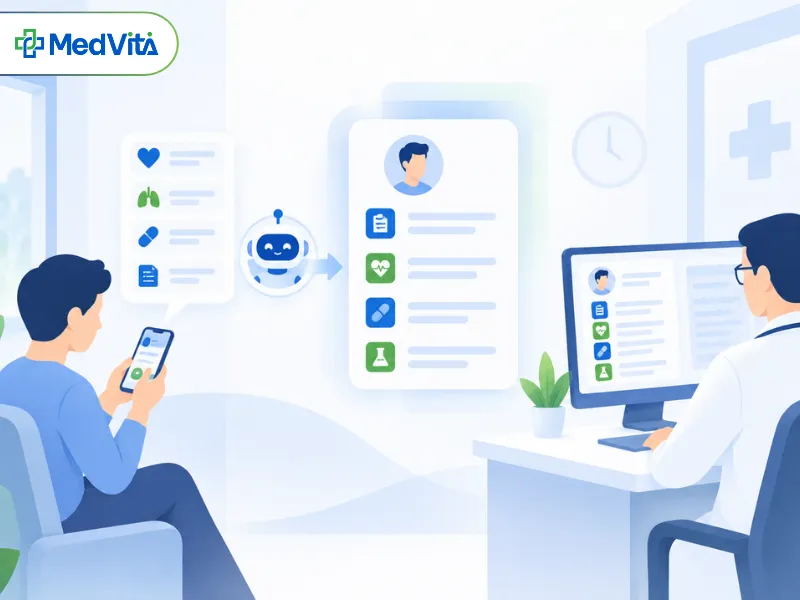
The AI system supports the medical interview process through interaction
According to MedVita's Smart Intake product information, the AI system uses a question-and-answer format to collect symptoms, medical history, current medications, and related information. Patients interact with the tool to provide data before meeting doctors. This approach transforms initial information gathering into part of the intake process rather than an activity that only takes place in the examination room.
The value of the AI system does not stop at recording answers. The collected data can also be compiled into structured medical history summary. Instead of doctors receiving a completely unorganized amount of information, the system helps prepare data so doctors have an additional reference source when beginning the examination process.
The important point is that the AI tool does not replace doctors' discussions and verification of information with patients. The medical history collected and summarized by the system serves as data preparation support, while doctors remain responsible for evaluating information based on professional expertise and actual conditions. This division of roles allows technology to support the examination process without shifting professional responsibility away from humans.
Patients become more proactive even before entering the examination room
A practical benefit of the AI patient medical history collection feature is that it allows patients to participate in information preparation earlier. According to MedVita's Smart Intake process, patients can use the application for declaration at home or at the hospital. This means preparation does not necessarily have to begin only after the patient is sitting in front of the doctor.
Pre-interaction also creates more space for patients to provide information related to their condition. Symptoms, medical history, and current medications are included in a collection process instead of relying only on patients remembering and presenting everything within the limited time in the examination room. The data is then organized to support the next steps in the healthcare journey.
From an experience perspective, patients no longer simply wait for their turn after completing registration. The pre-examination process becomes a valuable stage when information has already begun to be prepared. This is also the foundation for subsequent Smart Intake functions such as patient routing support and specialty recommendations to have initial data for processing.
Doctors have more pre-prepared information for the consultation
For doctors, the value of the feature does not lie in replacing medical interviews but in how data is prepared. After the interaction process, MedVita can compile information into a structured medical history summary and send it to doctors. Doctors therefore have an additional data source for reference and verification during the examination.
This organization approach aims to reduce time spent on information that could already be collected beforehand. According to the direction of the Smart Intake product, one of the benefits MedVita aims for is shorten examination time and increase specialized care time. When part of the initial data has been prepared, direct interaction time has more conditions to focus on topics requiring professional discussion and evaluation.
The AI system is therefore positioned to support doctors rather than become the party performing professional tasks. Technology helps collect and organize information, while doctors continue to review, supplement, and use data appropriately for each case. This also demonstrates MedVita's principle of technology accompanying people in the healthcare process.
Medical history collection is the starting point of a smarter intake process
The medical history collection feature does not operate as a separate step in MedVita. According to the Smart Intake process, after the AI system conducts medical interviews and collects information, the initial data is also used to support patient routing and specialty recommendations. The medical history is then summarized and transferred to doctors for the next examination step.
This creates a processing flow from patient provides information → system collects medical history → supports patient routing → summarizes medical history → doctor receives information. When steps are connected, the data provided by patients from the beginning can continue creating value in later stages. Intake therefore is no longer simply an administrative step before examination.
According to the product direction, the entire Smart Intake process aims at four values including reducing waiting time, shortening examination time, optimizing patient flow, and increasing time for specialized care. The medical history collection feature is one of the first links helping form this process. Technology is used from the beginning to better prepare data for both patients and healthcare teams.

MedVita brings AI technology into the pre-examination stage
MedVita positions Smart Intake as part of an AI platform supporting smart hospital operations. Within this, the AI medical interview and medical history collection system addresses a specific challenge: helping prepare patient information before meeting doctors. The technology is not deployed as an independent function but directly connected to the pre-examination journey.
This approach clearly distinguishes the value of AI technology and the role of humans. The system supports question-and-answer interactions, information recording, and creation of structured summaries; doctors receive, verify, and use appropriate information for professional activities. Patients also actively participate by providing data from the intake stage.
When medical history collection is connected with patient routing and the process of transferring information to doctors, MedVita aims for a more seamless pre-examination process. The value of technology therefore does not lie in replacing conversations between doctors and patients but in helping those conversations begin with better-prepared information.
Prepare medical history better to spend time on what matters more
AI patient medical history collection in Smart Intake of MedVita supports patients in providing symptoms, medical history, current medications, and related information before meeting doctors, while organizing data into a structured summary to support the next examination step. When information collection is moved earlier in the journey, patients can proactively prepare data, doctors have more information for reference, and hospitals have a foundation to work toward reducing examination time while increasing time for specialized care. The AI tool here does not replace medical interviews and professional evaluations but plays the role of preparing information so people can focus more on tasks that truly require expertise and direct interaction.